Monday, 10 December 2012

Win a Kindle Fire Loaded With 13 Books


Books on Fire Contest To Give Away Kindle Fire HD Loaded with Books

The Books on Fire contest, which runs through the end of December, is giving away a new Kindle Fire HD loaded with 13 books of science fiction, fantasy, and historical fiction. Sponsored by authors Judson Roberts, Ruth Nestvold, Luc Reid, William Hertling, Annie Bellet, and Del Law, Books on Fire can be found on the Web at www.kindlebooksonfire.com . In addition to the first prize winner of the Kindle Fire, ten second prize winners will win three eBooks of their choice from the list on the contest Web page. To enter, participants simply announce their three top book choices from the book list through any of these methods:


eBooks included in the prize pool include:

  • William Hertling's artificial intelligence thrillers Avogadro Corp. and AI Apocalypse
  • Del Law's merged worlds fantasy novel Beasts of the Walking City
  • Annie Bellet's crime novel set in the fantasy city of Pyrrh, Avarice, and her story collection Till Human Voices Wake Us
  • Luc Reid's novel of Vermont backwoods magic Family Skulls and his collection of flash fiction Bam! 172 Hellaciously Quick Stories
  • Ruth Nestvold's romantic Authurian novels Yseult and Shadow of Stone, as well as her collection The Future Imperfect: Six Dystopian Short Stories
  • Judson Robert's deeply-researched, adventurous Viking novels Viking WarriorDragons from the Sea, and The Road to Vengeance

See the contest Web site at www.kindlebooksonfire.com for full details.


Who are these handsome strangers?

Wednesday, 5 December 2012

Duotrope: Things Change


I've always been a supporter of Duotrope, using it heavily, promoting it when I could, donating money (directly and sometimes asking a story fee be donated anonymously) and diligently reporting all my submissions.

It was a good relationship. I was happy to donate my money and my data to the writing community, hoping that some newbie would benefit, as I benefited when I started out.

Come January that relationship will change, as virtually all the features will go behind a pay wall. That's their decision. And I wish them well as a new business.

But although I'm a frequent user, I won't be using it in future. As a more established writer, I can find the data elsewhere, for free (Ralan.com for instance) or from my twitter feed, or writing groups. For me, the goodwill has gone, and I'm hearing this a lot from my writing friends.

This makes makes a me a little sad. So, I'll leave you with a Duotrope screenshot. The more observant of you, may recognise the story featured.


Money Flow From the Writer at Publisher's Weekly

Friday, 30 November 2012

Confessions of a Museum Bunny: Inspiration for Short Stories


First appeared in Science Fiction Writers of America Blog   August  2012

Ideas for my stories come to me in museums, in galleries, in gulibraries. Find me upstairs (and it’s always quieter upstairs) in the British Museum trawling the past looking for future inspiration.
Old books, paintings, objects are part of our material heritage. Survivors of the ravages of times, sometimes cherished throughout the ages, sometimes forgotten, dug from the ground, broken and then reconstruction. Objects tell stories. Museums select and interpret these stories, grouping objects together to give a window into the past.
Museum objects are rich in concrete detail for stories. And not just for fantasy stories, set in the real or imagined past. A detail from the past can act as a springboard for a story about the future. Looking at the helmet of a 10th century Norwegian chief leads me to consider what armour a space Viking might wear (Space Vikings! Now I want to write a space Viking story). Looking at a beaten gold headdress from ancient Ur makes me wonder how the woman felt wearing such a beautiful and precious item. How did her society shape her? How will my future society shape my characters? An object in a museum will catch my attention. Why was this sword engraved with the image of a bear? And that will send me down a pathway of research. 

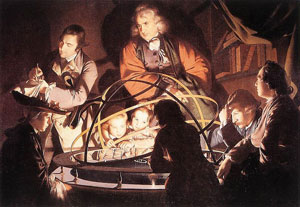
A Philosopher Lecturing on the Orrery, by Joseph Wright, 1766 (Deby Museum and Art Gallery)
Some museums collect the finest pieces of the past, the most costly, the most cherished. Objects may be monumental, priceless and awe-inspiring. But these are not the only stories to be told. Sadly many objects from the past of the working person have been lost. Yet, you can still glimpse the lives of working folk painted as rural scenes on objects. And social museums seek to recapture a glimpse of the ordinary, the everyday.
Objects, books and paintings are material records of the stories told in the past, the stories of religion and mythology. You can read the changing nature of stories through objects. Creation stories, eschatologies, the stories of the gods as their worshippers migrate and change, stories of lovers seeking to retrieve their beloved from the underworld. Some stories are repeated through the ages. What element has gripped so many imaginations?
Musuems don’t always look backwards. In the British Museum’s African Galleries there’s a sculpture called Tree of Life (2004) constructed out of decommissioned rifles. Science museums examine the science of the past, the future and even trends for the future.
The presence of an object in a museum in a story in itself. The Parthenon Marbles, the Benin Bronzes (and others) on display in London are subject to repeated calls to be returned to their countries of origin. These objects tell stories of colonialism, empire, and war.
Though I love the massive, wealthy London museums and galleries, I’ve a fondness for the more obscure museum. After all, I used to work for one, as curator of the Royal Veterinary Museum. In London you can visit Alexander Fleming’s laboratory, or visit the Royal College of Surgeons Museum to explore the ideology that underpinned medicine for thousands of years. University are centres of research and specialism. Their collections are often open to the public by appointment. It’s worth trying a visit to a museum outside your area of interest. Volunteering to help out during my daughter’s school trip took me to the Imperial War Museum, I saw a wealth of cool spy gadgets that will no doubt work their way into some of my stories.

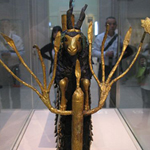
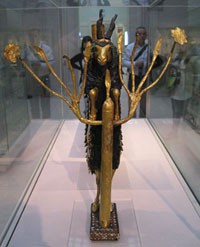
Ram in a Thicket (2600-2400 BC) from Ur, in southern Iraq, British Museum
I live in London, and this article has been about London’s cultural wealth. But you can find wonderful museums everywhere. Holidays at home or abroad are opportunities to glimpse other cultures. A family wedding in Cyprus found me in a small museum examining of hundreds of votive offerings, clay figurines of a men on horseback. A collection that I couldn’t have seen anywhere else. I’m Derbyshire born and bred. Derby’s Museum has a wonderful collection of Joseph Wright of Derby’s atmospheric paintings exploring the development of modern science during the Enlightenment. A bus ride from my home town takes me to the D.H. Lawrence Museum, and to the National Trust’s Museum of Childhood. And sometimes history can’t be constrained to a building. I like the prehistoric stones ring at Arbour Low in Derbyshire that sometime in the past has been pushed over. The standing stones are fallen, nobody remembers why. There’s history everywhere.
And there’s the internet. Museums have embraced the internet seeking to widen access to their collections. It’s not, in my opinion as good as seeing the real thing. (Who can forget standing under the real-size model of the Blue Whale at the Natural History Museum?) But museum websites are a valuable resource.
And if you do take a trip to a museum, don’t forget to take a tour. Curators love to talk their collections. They have a passion for them. And curators are people who want to communicate stories. I should know; I used to be one.
•••
Two of Deborah’s stories inspired by the London’s cultural heritage are “The Bio-Documentarian of the British Library” published in Cosmos, and “Green Future“ published in Nature’s Futures.

Sunday, 25 November 2012

Words of Encouragement: Subbing to your Dream Publication

I've met quite a few writers who don't sub any to their dream publications, because they tell me there's 'no point'. And I can empathise with that. But here I offer a poem of encouragement:


They All Said it Couldn't be Done
Anon

They all said it couldn't be done
but he, with a grin, replied,
'I've never been one to say it couldn't be done
leastways until I've tried."

So he tried that thing that
couldn't be done.
By golly, he went right to it.
He tackled that thing that couldn't be done,
and found he couldn't do it.

#

This used to be my party piece when I was a kiddy. It's always made me laugh. And it pretty much sums up getting an acceptance from the professional press (or your dream publication). It's tough, but I do it anyway. And sometimes I do do it.

note: this poem is a parody of a more inspiring poem, but I prefer the version I gave you.

#

Linkage

Where do you get your ideas? The story of a story:
Joanne Merriam at the Journal of Unlikely Entymology.

Bryan Thomas Schmidt guest blogs at Catch a Star as it Falls:
Ten Tips for Getting Past Writer's Block

A favourite topic of mine. Turn that frown upside down:
Thoughts about rejection from Kelly McCullogh at  the Magical Words blog

Thought from mystery and crime writer, Laurence O'Byran
A Sense of Mystery: What makes you read on?

An Insight into Research from Shimmer editor and writer, Elise Tobler
Pineapples Everywhere: The Dominoes of Research

Tuesday, 20 November 2012

Must Artists Suffer? A New Story up at New Scientist's Arc


It's a story that plays with the supposed link between unhappiness and art. What do you think? Is there a link? My main character thinks so, but I don't agree. This story was lots of fun to write.  You can enter the debate at the Arc site, if you've a mind. 

And Arc have announced their new competition: 'Is the Future Friendly?'

Here's what the editor kindly said about the story: 


Arc’s winning stories: Deborah Walker’s Drink Deep and Long the Circean Poison

Must artists suffer? The novelist and poet Thomas Hardy thought so, quipping that “light writes white”. Aldous Huxley’s Brave New World  is a narcotised shopping mall, its zombie denizens, blissed into political quiescence.
Deborah Walker (@deboree), a runner-up in our recent short story competition, broadly agrees - but her story, set in a world where pleasure has been harnessed and commodified, is altogether more mischevious. There is no conspiracy here, no attempt to defraud humankind; only a technology that speaks to some very deep, politically uncorrect (and largely male) assumptions about what greatness is, and how it can be achieved.
It’s also a playful period piece that, in its attention to detail and speech rhythms, knocks all that steampunk malarkey out of the court

Thursday, 15 November 2012

Taking you Blog to the Next Level

A nice post from speculative writer Rahul Kanakia about taking your blog to the next level.  I enjoy Rahul's blog a lot, plus he's a great writer, so he get's my thumbs up for a follow.

Many of the things he mentions I don't do.

But this could all change. It would be nice to have more hits.  He mentions people linking to his blog, which I believe is important for your position in the search engine rankings.

Much to think about.

Any good tips for improving blogs? Is it something you think about?

What I've done so far

  • signed up to Google Analytics
  • tidied up the blog
  • added top stories link

Monday, 12 November 2012

Speed of Love

Hello to the people popping in from Daily Science Fiction. My story, 'Speed of Love' was sent to subscribers' e-mails this morning.


It's set in Avebury. Which is an amazing stone circle in Wiltshire. Those stones are big. About double debs sized. Hope you enjoyed the story.

Friday, 9 November 2012

Priorities for the Short Story Writer: Part One: Submissions

Warning: Mileage will vary. This is how I manage my submissions. You might do things much better.

#
This has got to be a golden age of opportunity for the short story writer. Duotrope lists thousands of venues.

But, in a whiny sort of way, I've been feeling stressed by too much opportunity. I thought I'd blog about how I've been attempting to organise my time.

And let's pretend that I just write shorts. I'm also writing poetry, and many of you are writing novels, too. Let's put that aside.

If you want to get published the aim of the game is to get your stories in front of editors. Occasionally I've sold without submitting (when editors have seen a story link on my blog) but its rare.

To increase your number of submissions, you can do two things: make more submission, write more stories and then make more submissions.

Guide to Making More Submissions.

1. Query Any Current Overdue Submissions. 

If you've been subbing for a while you might have overdue subs, submissions  that are taking longer than is usual (usual can vary widely). It's is not unknown for venues to die on me without me noticing. Check duotrope.com and the venue itself for response times.  This is how I query by e-mail.

Dear X editors,

I wonder if my submission is still under consideration.

Kind regards,

Deborah

I always forward the original e-mail, making sure the story is attached, in case it's been lost. Nine times out of ten this brings a very quick response, a sale or a rejection or a holding notice. If I don't get a response in a reasonable time (two weeks is reasonable to me) I politely withdraw the story. It's important to withdraw so that you have documentation if a dispute arises in the future.

Dear X editors,

I would like to withdraw my submission sent to you on xxx.

Kind regards,

Deborah

I usually forward the query letter and original submission, but, I don't like to go into the whys and wherefores of the matter. But that's your call.

2. Make Reprints Submissions

I don't make enough reprint submission which is very foolish of me, as I consider them pain-free. If you get a rejection, you know that it's due to editorial taste. After all the story has already been published.

There are many quality reprint venues that you can find using duotrope.com's nifty reprint search function.

3. Make Submissions from your Inventory.

Send out the stories that you've already written. A really nice tip, which I've never managed, is to send a story to a new venue immediately when you get a rejection.

There is a time cost to making submissions. If you have a lot of stories, you could probably spend all your time subbing. I suggest picking a number that you feel happy with, for me that 40-50 story submissions. If my race score gets low, like it is at the moment, I like to make a story submission a day, until it gets to a good level.

Be strong, Grasshopper. Do not get discouraged by rejection.

4. Write a New Story and then submit it.

You can either write whatever you feel like and then find a venue. Or you can find a venue and try to write a story that fits.

But how do you decide what venue to write for? And in fact, how do you decide where to send inventory stories? I've got some thoughts. And that's going to be the subject of part two.

#


I'm interested in how you guys manage your submissions. Is it much like me? Are you happy with the number of submissions you've got out at the moment? Anything that I've forgotten, or gotten outrageously wrong?

Thursday, 1 November 2012

November PAD poem-a-day

I suspect many of you are busy with nanowrimo-- but here's another challenge, November Poem-a-Day courtesy of Robert Lee Brewer on the Writer's Digest site.

My poetry inventory is very low, I'd love to get it hight enough to do some serious subbing.

I enjoy writing poetry and it really helps with short story writing. Some of my big sales started life as a poem.


Here are the basics of the challenge:
  • Beginning on November 1 (Atlanta, Georgia time), I will share a prompt and poem each day of November on this blog.
  • Poets are then challenged to write a poem each day (no matter where you live on the planet) within 24 hours (or so) from when the prompt is posted.
  • Poets do NOT have to register anywhere to participate. In fact, poets don’t even need to post to this blog to be considered participants.
  • The Challenge will unofficially conclude around 24 hours after the final prompt is posted. That said…
  • This Challenge is unique, because I expect poets to take all the material they’ve written in November and create a chapbook manuscript during the month of December. (Yes, you can revise material, and yes, the chapbook should be composed mostly of poems written for the challenge–I’m using the honor system.)
  • Poets have until 11:59 p.m. (Atlanta, GA time) on January 7, 2013, to submit a manuscript that can be 10-20 pages in length (not including table of contents, title page, etc.) with no more than one poem per page. So if you wrote 50 poems in November, you have to narrow them down to the best 20 (or even fewer). Submit manuscripts to robert.brewer@fwmedia.com with the subject line: 2012 November PAD Chapbook Challenge. (The subject line is very important.)
  • The goal will be to announce a winning manuscript by Groundhog Day 2013.
*= Hoorah. I've done a first draft. **Blimey, completed poem=5/30 Sold 4

day 1: matches poem = Fundamental**                  

day 2: full moon poem = Under Hunter's Moon** sold to Eternal Haunted Summer              
day 3: scary poem = Rain Worm*                         
day 4: just beneath poem = Yakshini*                   
day 5: text message poem = Calligraphy*              
day 6: left right = Lateralization*                            
day 7: circle poem = Tycho*                                 
day 8: rebuttal poem=? Moon Train*                      
day 9: When he's gone poem= Bird Beak Man*      
day 10: foreign word poem = Riding the Juggernaut**               
day 11: Veteran poem= 'London Necropolis Station'**   Sold to Tales of the Talisman             
day 12: imaginary technology poem= Chronostasis
day 13 :letter or recipe
day 14: stuck poem = petrification*
day 15: trade-off
day 16: last line
day 17: how to ....
day 18: regional cuisine
day 19: wheel poem='Throne.'*
day 20: let's 
day 21:song title
day 22: paradise
day 23: deep
day 24: truth about
day 25: opposite
day 26: collection
day 27: hero and villain
day 28: workplace
day 29: birth poem = 'Utterly Pure'** sold to Eternal Haunted Summer 
day 30: milk poem= 'Ocean of Milk'** sold to Eternal Haunted Summer

edited. 26th November: Boy, do I stink at challenges. Nothing complete yet, and quite a few not attempted. (more than half). Fear not. I haven't given up. I should have a good bash at this, this week. 

edited 4th January, still haven't given up. But many left to do. On the plus side, I've sold one. 

Friday, 26 October 2012

New Story Online

 My story, 'Glass Future' is online at Nature's website.

I got my hard copy through the post today. Excellent. Great illustration for my story from the talented JACEY.

Tuesday, 23 October 2012

'Not Just Rockets and Robots': Are You in it?

book
This is an anthology of the first year's stories from Daily Science Fiction, and what a monster it is. With more than 425,000 words. I've got a story in here, and so have some of you. Give me a shout out if you have, because I'd like to re-read your story. 

Daily Science Fiction will send a fantasy or science fiction story to your e-mail every week day for free , and is open to story submissions. 

Tuesday, 16 October 2012

Short Story Techniques: False Documents Plus Healthy Writers Club

CLOCKWORK PHOENIX 4Clockwork Phoenix 4 is open guidelines here, and I'm re-reading Clockwork Phoenix 3. Editor, Mike Allen, ran a successful Kickstarter campaign, and Clockwork Phoenix 4 is paying pro rates. And factor in the the roar of critical approval that met the previous anthologies, there are going to be a lot of people subbing. But, hey, I've always liked a challenge.

Clockwork Phoenix 3 gets the Deb's thumbs up of approval, both a story level and at a craft level. In fact, I'm going to do a few posts looking at techniques in stories from the collection.

Tomorrow is St Valentine's Day, by Tori Truslo is a beautiful and strange retelling of The Little Mermaid set on the moon. Truslo creates  false documents to tell the story: diary entries, letters, poems, academic papers. I actually dislike the term false, as the documents are real in terms of the story, but I can think of a better one. Truslo also quotes and riff's off a real-life document, an extract from Hamlet.

False documents are often used to head section in a short story, The Zepplin Conductors' Society Annual Gentleman's Ball, by Genevieve  Valentine is a lovely example.

Wiki's entry on false documents say that they create an illusion of truth for the reader. I really can't agree with that. What I think they do is offer the author a clever way of introducing other point of views within the narrative, and expanding the world building at a relatively small cost of words. Something's that's important to the short story writer. There's a distancing effect also, I think in telling the story in this way. It's a very interesting technique. I must ponder more upon it.

I haven't used this technique in any of my stories yet. But I want to. What about you? Have you used false documents in your stories?  Do you like the technique?


A writer update for the Healthy Writers Club, hosted by Shallee McArthur  Sign up here. Wow. I'm loving it. What is it about writing things down on my blog that makes me feel obliged to do it.

I have certainly done more exercise this week because of the club, sneaking in extra walks, a swim and a bike ride. Although I must admit It went a bit pear-shaped at the weekend, but onwards.

So much so, that I'm inspired to increase my daily walk target to 1500 steps or 12km. Trying to do a bike ride and a swim and my ten a day fuit and veg challenge. Bring it on.

Wednesday, 10 October 2012

Amazon Rankings

Hey, Amazon.com have just e-mailed me my author ranking. I can proudly announce I am #650,000.

But hold on a minute, all my but one of the books I've appeared in have disappeared from my page.  This will not stand.

I've already added one, so I better get the rest done. *laughs* And it's updated hourly. That's something else to distract me.

What about you, readers? Are you busy updating your Amazon page today? What do you think of this new feature? Has anyone else got a ranking lower than me? Anybody in triple digits?

I'll update as I climb through the rankings. Or I might descend. Then I won't mention it.

edited. Aha, my ranking is just counting books, not e-books. Got to wait until Amazon confirms me as author.