I'm pleased to announced my story 'The Rebirth of Mr Scratchy Claws' has been published in Lazarus Risen.
Dreams of immortality and eternal youth are almost as old as human culture itself. But what would the world look like if everyone could live and be young forever? What would it look like if only some of us had that privilege? Lazarus Risen presents sixteen stories from around the world that explore the economic, political, social and psychological consequences of life extension, human cloning, the hard upload and other forms of the biological singularity.
Stories by Brent Nichols, Sean McMullen, Teri Babcock, Nancy SM Waldman, Brad C. Anderson, Fiona Moore, Felice Picano, Matthew Shean, Matt Moore, Suzanne Church, Peter Wendt, Holly Schofield, Deborah Walker, Kevin Edwin Stadt, Leigh Kimmel, and Andrew Barton
Monday, 19 September 2016
Wednesday, 14 September 2016
Kyu, The Unknown: A Book Birthday
I am so pleased to have Paul Magnan on my blog to talk about his debut novel, 'Kyu, The Unknown' I first met Paul when I was a wide-eyed newbie, and since then I've followed his career with great interest. And now a novel! A storty decades in the making. Bravo, Paul!
First off, I want to thank Deborah for her invitation to post on her blog. It is appreciated. 
Anyway, on to my debut novel, "Kyu, The Unknown, Book 1: The Coming of Dis", released on the 9th of September by the wonderful people at Writers AMuse Me Publishing, who publish an eclectic variety of books, many of them award winners.
In a nutshell: Kyu is a famous and popular arena fighter in a world that has a few traditional fantasy elements, but has been allowed to evolve technologically (While I enjoy straight-up fantasy stories, I never understood how technological advances never happened in them. Sure, they have "magic", but 3000 or more years with no basic inventions even considered, like a printing press or even firearms? I could never buy that, so I made sure my book didn't have that issue). Kyu's world is a mega-continent called the Territories, the last human land on a planet almost completely engulfed by the Disian Curtain. Behind the Curtain are creatures called Infernals, ruled by Diaboli Domini, who not only want, but need, to feed on human souls. And the Curtain is creeping ever closer to the human land.
The humans, sadly true to form, are ignoring this greater threat to plot among themselves, split between political and religious differences. Kyu discovers he has a connection to both realities, and, with a determined but novice politician named Erenia, must convince the population of the Territories to band together, militarily and spiritually, to fight off the coming invasion, or lose everything forever.
"Kyu" is not a recent idea of mine. Actually, he's been with me under one form/name or another since 1980. He didn't even start out as prose. He came into being as a comic strip character I created as part of a project for my high school art class. I drew him as wearing a heavy black cloak, with his face hidden inside the darkness of a hood. As now, he had claws for hands and was an arena fighter.
His name then was The Unknown Flurg, and he was an instant hit with my classmates, who encouraged me to create more strips. My teacher, though appreciative of my efforts, thought Flurg was a bit too violent, which was undoubtedly true.
I had already written a few basic stories at this stage, so it wasn't exactly a giant leap of logic to start writing instead of drawing Flurg. When I graduated in 1981, I still hadn't finished this novel-in-the-making. Next to my picture in my high school yearbook is the message "To those who knew him, remember the Unknown Flurg; to those who didn't, well, perhaps you'll read his story in the future."
Thirty-five years later, with his name changed for a variety of reasons, they now have that chance.
It took three years for me to finish that first novel. It was rough and undisciplined, to be sure, but I think it had a certain charm, and many of the main characters (who also have undergone a lot of changes since then) in the present novel were introduced.
Then I took a twenty year hiatus.
Why? It's hard to say. I just put my life on cruise-control, pushing past things I should have dealt with, but didn't. I went to work after high school in a factory, and didn't go to college until two years later, and even then it was part-time. Eventually I earned a Bachelor degree in Marketing, which collects dust to this day. Maybe it was because I was told by more than one person that pursuing a degree in English was worthless unless I wanted to become an English teacher, which I knew I didn't want to be. Maybe it was because I was told that fiction writing was a thankless, barren field, where to make a name for oneself was almost impossible. Maybe it was nascent depression, which has plagued me most of my life, making itself at home and comfortable within me, encouraging self-doubt and apathy to come in as roommates.
Then, around 2005 or so, I lost a lot of weight and my creativity came back. I started writing short fiction. I made like-minded friends on the Internet, who helped teach me how to write. And I looked back on Flurg and brainstormed. And brainstormed. And brainstormed again. I started making notes, building the world in which he lives, making changes to him and other characters, and introducing new characters, main ones of importance. A year later I had a rough, 120,000-word manuscript. I dove right back in and wrote two sequels of similar length.
Then I took another hiatus, but this time it was to polish my craft with short stories and learn from the critiques of various established authors I had met and befriended in various writing forums. Over the next couple of years I worked at my craft, and started to sell stories to non-paying and token-paying venues, working my way up to semi-pro and pro markets.
I turned back to Flurg. I did a ton of editing, slashing away several thousand words. Once I felt it looked halfway decent I looked into independent publishers, as I had no luck in finding an agent.
Writers AMuse Me Publishing is the brainchild of someone who runs a fantastic writing forum called The Writers Block. Her name is Mary, and she accepted my book.
Then we went to work...and work...and work...and more work. Mary and her team were instrumental in knocking away much that was unneeded and inhibiting in the book, teaching me so much as we went along. She sent back chapters with a LOT of red to be acted upon. There were times when I wanted to run and hide. I persevered, and after a few months of slashing and learning (on my part), and name changing (Flurg to Kyu), the novel was finally ready for publication, and here it is. It is also available for purchase in both Kindle and print form though Amazon and as a NOOK book through Barnes&Noble.com.
Once again, thank you, Deborah, for allowing me this opportunity to write on your blog!
#
Paul, you're welcome, and I'm looking foward to the read.
Tuesday, 23 August 2016
Happy Book Birthday, Breath of Fire
Happy Book Birthday to my writing friend, Beth Cato
In an alternate 1906, the
United States and Japan have forged a powerful confederation—the Unified
Pacific—in an attempt to dominate the world. Their first target is a vulnerable
China. In San Francisco, headstrong Ingrid Carmichael is assisting a group of
powerful geomancer wardens who have no idea of the depth of her power—or that
she is the only woman to possess such skills.
When assassins kill the
wardens, Ingrid and her mentor are protected by her incredible magic. But the
pair is far from safe. Without its full force of guardian geomancers, the city
is on the brink of a cataclysmic earthquake that will expose Earth’s powers to
masterminds determined to control the energy for their own dark ends. The danger
escalates when Chinese refugees, preparing to fight the encroaching American
and Japanese, fracture the uneasy alliance between the Pacific allies,
transforming the city into a veritable powder keg. And the slightest tremor
will set it off. . . .
Forced on the run, Ingrid
makes some shocking discoveries about herself. Her powerful magic has grown
even more fearsome . . . and she may be the fulcrum on which the balance of
world power rests.
---
This excerpt from chapter 1
offers an introduction to geomancy.
Whimpers and moans welcomed Ingrid
to the junior classroom. Nearest to the door, a dozen boys half sprawled over
their desks. A blue mist overlay their skin, and beneath that mist were the sure
signs of power sickness—skin flushed by high fever, thick sweat, dull eyes. The
rest of the class stared, their expressions ranging from curiosity to horror.
Some of them still showed signs of very recent recovery in their bloodshot
eyes. None of these boys was older than ten; the youngest was a pudgy-faced eight.
"There you are!" The
teacher scowled, as if it were Ingrid’s
fault he’d been so inept with
his accounting. Biting her lip, she held out the bag. He snatched it from her
fingertips.
The chalkboard laid out the
terminology of the lesson, one
Ingrid had seen taught dozens
of times: hyperthermia, hypothermia, and the quick timeline to a geomancer’s
death. These young boys experienced the hard lesson of hyperthermia. The last
earthquake noticeable by the wardens had taken place
three days before. These students
had been directly exposed to the current and hadn’t been allowed access to any
kermanite. As a result, they spent the past few days bed-bound in misery as
though gripped by influenza.
Thank God none of them were as
sensitive as Ingrid. Another direct tremor would cause their temperatures to spike
even more, and could even lead to death.
The teacher adept pressed a
piece of kermanite to a boy’s skin. He gasped at the contact. Blue mist eddied
over his body, the color evaporating as it was pulled inside the rock.
If she could see the kermanite
in the adept’s hand, the clear crystal would be filling with a permanent smoky
swirl. It took a trained mechanic to rig an electrical current to tap the
trapped magic as a battery. When the energy within was exhausted, a crystal
turned dull and dark. Once that happened, kermanite became a useless rock.
The young boy sat up
straighter. "Thank you, sir," he whispered,
voice still ragged. It would
take him hours to fully recover.
Ingrid looked away, that
familiar anger heavy in her chest.
Wardens and boys in training
carried kermanite openly from
watch fobs and cuff links, or
most any other accessory where
stones could be easily
switched out once they were full.
She had to be far more subtle.
Her kermanite chunks clinked together in her dress pocket. She had to take care
not to touch them today, or the energy she held would be siphoned away.
Ingrid loved this slight flush
of power, because that’s what it was — power. It sizzled just beneath her skin,
intoxicated her
with how it prickled at her
nerves. Certainly, if she absorbed
any more energy, she’d use the
kermanite. She didn’t want to feel sick, though she could hold much more power
than these boys, or even the wardens. Mr. Sakaguchi said she took after
Papa — that she stored power
like a bank vault, while most
everyone else had the capacity
of a private safe.
When it came to her natural
skill, Ingrid often regarded herself as a rare fantastic or yokai — not like
garden ornamentals like the kappas or naiads sold to the stuffed shirts on
Market Street — but like the geomantic Hidden Ones Mr. Sakaguchi so loved to
research. She was a creature relegated to idle fancy and obscure mythology, and
aggravating shoes.
---
---
Beth Cato is the author of the
Clockwork Dagger series from Harper Voyager, which includes her
Nebula-nominated novella WINGS OF SORROW AND BONE. Her newest novel is BREATH
OF EARTH. She’s a Hanford, California native transplanted to the Arizona
desert, where she lives with her husband, son, and requisite cat. Follow her at
BethCato.com and on Twitter at @BethCato.
Monday, 8 August 2016
How to Sell Reprint Short Fiction
Milford is the Milford SF Writers’ Conference, a peer-to-peer workshopping week, held annually in beautiful North Wales.
I attended a few years ago, and I was delighted to offer some reprint advice to their new and improved blog.
This year Milford is offering two bursaries for Writers of Colour to attend in 2017.
I attended a few years ago, and I was delighted to offer some reprint advice to their new and improved blog.
This year Milford is offering two bursaries for Writers of Colour to attend in 2017.
Friday, 29 July 2016
16 Week Marketing Strategy for Short fiction
Tannara is a fantasy author who has
just started selling her short stories. Her latest one, "Autumn Road to
Yessar" appears in The
Great Tome of Fantastic and Wondrous Places by Bards and Sages Publishing. You can
visit her at tannarayoung.com.
Hurray – you've
sold a short story! Now you want to get the word out there. Sure it's just a
short story, but if you're like me, you want to get better at marketing so that
when you publish a novel, you already have some of the skills to jump into the
big time marketing.
In my post Marketing 101, I
mentioned starting out overwhelmed by all the advice in articles, books, and
blogs. Despite that overwhelm, it is really nice that people are willing and
eager to share their expertise and ideas. I am still developing my expertise, but
I am happy to share my ideas for version 1.0 of my
Marketing Strategy.
Here is the bare
bones of my 16 Weeks Marketing Strategy. This strategy should be started 12
weeks before your story comes out: Week 12 is the Official Launch Week
Week 1 – Assess
Where You Are
Think about what
you already have going and if you want to add any other platforms:
- Are you current on your social media sites?
- Do you want to open any other social media accounts?
- Do you have a web page or blog? There are great free
options such as Blogger and Google Sites if you don't want to pay for a
service.
- Is all your contact information current?
- Do you have an author biography?
- How about a list of
published works – with links if they are published online?
Week 2 – Build
your Base
Brainstorm a few
ways you can increase your reach
- Maybe a new social media account where your readers
hang out?
- How about commenting on blogs with relevant topics?
- If you are in an anthology, reach out to your fellow
authors and consider how you can support each other – for example, guest
blogging like this post.
- Think about your
audience for this particular story: maybe it's suitable for young adults
as well as your regular adult readers. Maybe it would appeal to boat
enthusiasts, or it's about delicious food. There might be readers out
there who wouldn't normally find your story, but who might be interested
if you reach out to them.
Week 3 –A
Picture's Worth a Paragraph
Pictures draw
people in, yet for short stories authors seldom bother to create postcards,
bookmarks or online graphics to generate interest. If art and graphics are not
in your skill set, maybe you can find a friend who will help out for a trade:
you could polish the written part of their online gallery, or wash their car,
or make them a home cooked meal…
Images to gather:
- Image of the book cover, or if it's an online
publication, the logo or an images associated with the publisher.
- A photo or drawing representing your short story within
the larger publication.
- Author Photo – if you don't want your head-shot out
there, think of other creative images to use: an silhouette of you against
the sea, your hands writing in a notebook, your favorite plush wombat.
- Any other logos, such as
the publisher, or venues where the story will be available (Amazon,
Smashwords, your local bookstore, etc.)
Week 4 – But
Words are What We Work With
Is it enough to
say "My short story 'The Bells of New York' is now available at in XYZ
magazine?" I know I am more likely to read something that has a little
blurb about its contents.
Text to prepare:
- A logline for your story
- A logline for the publication
- Sample posts and tweets about it for social media
- Quotes from reviews
- An excerpt from the
story
Week 5 – Images
and Words Together and Planning Tactics
Now put your
images and words together to make interesting blog posts, a poster you can put
up in your local coffee shop, or a postcard you can send online.
Make a list of
tactics you are going to do for your marketing plan – such as:
- Post to social media
- Hang posters
- Go on a Blog Tour
- Ask for Reviews
- Host a Launch Party
Week 6 – How will
you Celebrate?
I am a big fan of
Launch Parties. They are both a tool for promoting interest in your work, and a
way to celebrate a success. They are not for everybody – maybe you hate parties
or are too busy. But consider doing a little something to send your work into
the world.
Launch Party
Planning
- Where and when: the idea is to be
public – but you can also do it with just friends and family. Think of a
venue or a theme that fits your story. If it's set in the roaring 20's,
invite your friends to a speakeasy party. If it takes place by on a boat –
hold it at the beach or a lakeside park. If you want to do it in a
business, be sure to discuss it with them. Or hold it online.
- What and who: Typically book launches
include a short reading by the author, a time for Q and A and some sort of
refreshments. If you're in a coffee shop or pub the refreshments might
take care of themselves, but otherwise think about your story again. If
it's a carnival themed story, have little boxes of Caramel Corn, etc.
Invite your friends and family – or make it a Facebook Event, or post a
notice in your local paper's event calendar.
- If you are not up to
hosting a launch party – or it seems like too much for the scope of the
story you published – at least find a friend, pour a glass of something
and toast the launch of a few of your words into the world!
Week 7 – Official
Announcement
Now that you have
some marketing materials made up and hopefully know about when your story will
be out:
- Craft an official announcement to post on your blog,
website, and social media sites. Make it pretty with your images, make it
intriguing with your log-lines and be sure to add any links to pre-release
pages.
- Update your email
signature to note that the publication is coming
Week 8 – Prepping
the Plan
Create a
marketing calendar for all your tactics – ex:
- Are you going to put up posters? When?
- Are you going to ask for reviews? When?
- Is there a deadline for
submitting an announcement to a newsletter or local paper?
Week 9 – Spend
Something to Get Something
Create a
marketing budget for yourself
- Will you have anything printed?
- Will you spend anything on a launch party?
- Are there any other
tactic you might be spending something on?
Week 10 - And go!
Start following
your list of tactics:
- Contact reviewers
- Exchange guest blogs
- Plan your party
- Print posters
- Keep up with your
regular posts and social media activity
Week 11 - Gain
Momentum
Follow your
Marketing Calendar
- Keep up with any deadlines
- Prewrite reviews and blog posts to save yourself time
later
- Invite guests to your Launch Party
- Offer advanced reading
copies if appropriate
Week 12 -
Publishing Week
It's out! It's
there for you readers to enjoy!
- Post the news
- Host a Lunch Party
- Update your email signature, list of works published,
biography, etc.
- Ask your readers for reviews
- Follow your Marketing
Calendar
Week 13 – Keep it
Fresh
- Post reviews you've gotten
- Post any news from the launch week
- Post pictures from your launch party
- Keep up with anything on your Marketing Calendar
- Is it in hard copy? Ask your fans to post pictures of
them reading it.
- If there are other
stories appearing in that issue or publication, post reviews of them.
Week 14 –
Acknowledgments
Take a moment to
thank those who helped you – reviewers, friends, the coffee shop that hosted
your launch party.
Week 15 –
Wrapping Up
Finish any last
items on your marketing calendar.
Week 16 –
Reflections
Think about what
you did for this story.
- What worked?
- What didn't work?
- What brainstorms did you have?
- What would you have done
differently?
There are many
other tactics that can be used for marketing your writing: book signings, book
tours, attend a convention, participate in local arts events like First Friday,
or Open Studios. Most of these are more likely to be worth your time and effort
when you have a novel to promote or the anthology is all your own work.
However, there's nothing wrong with keeping a list of marketing ideas and
adapting them to anything you publish from a short story to an epic series.
And hopefully
like me, each time you do it, you will get a little better at marketing your
work.
Tuesday, 12 July 2016
Speed of Love
I'm pleased to see 'Speed of Love' reprinted at Hero and Heroine III, with some lovely cover candy for my story.
Tuesday, 5 July 2016
Glass Future in QuickFic Anthology 2
Pleased to be making new TOC buddies with the publication of the QuickFic Anthology 2 which reprints my Nature's Futures story Glass Future.
Here they are (some of these names are a tad familiar):
Includes stories from: Holly Schofield, Eddie D. Moore, Ken MacGregor, Brenda Anderson, Jon Gauthier, Wendy Nikel, Jason Lairamore, Aeryn Rudel, S.C. Hayden, Preston Dennett, Deborah Walker, H.L. Fullerton, Stewart C. Baker, Doree Weller, H.A. Titus, Tara Calaby, Fred Waiss, C.M. Saunders, Karin Fuller, Kolin Gates, Lisa Finch, Pedro Iniguez, H. A. Titus, Jamie Gilman Kress, Liam Hogan, Alex Shvartsman, Nick Nafpliotis, Amy Sisson, DJ Cockburn, E.E. King, Tanya Bryan, Ian Whates, David M. Hoenig, M.J. Sydney, Chuck Rothman, Desmond Warzel, Gregg Chamberlain, Suzie Lockhart, Bruce Lockhart 2nd
Here they are (some of these names are a tad familiar):
Includes stories from: Holly Schofield, Eddie D. Moore, Ken MacGregor, Brenda Anderson, Jon Gauthier, Wendy Nikel, Jason Lairamore, Aeryn Rudel, S.C. Hayden, Preston Dennett, Deborah Walker, H.L. Fullerton, Stewart C. Baker, Doree Weller, H.A. Titus, Tara Calaby, Fred Waiss, C.M. Saunders, Karin Fuller, Kolin Gates, Lisa Finch, Pedro Iniguez, H. A. Titus, Jamie Gilman Kress, Liam Hogan, Alex Shvartsman, Nick Nafpliotis, Amy Sisson, DJ Cockburn, E.E. King, Tanya Bryan, Ian Whates, David M. Hoenig, M.J. Sydney, Chuck Rothman, Desmond Warzel, Gregg Chamberlain, Suzie Lockhart, Bruce Lockhart 2nd
Wednesday, 22 June 2016
Aunty Merkel Marks My Seven Hundred Fifty First Sale
Pleased to see 'Aunty Merkel' in this free to read Wattpad collection of very short stories. This is my 751st sale. Not too shabby.
Monday, 20 June 2016
'Frozen Hive' and 'Pure and Without Savour' Sold to Estonia
'The Frozen Hive of Her Mind' first published in Nature's Futures and 'Pure and Without Savour' first published in SF Comet have been published in Esotonian transaltion in Reaktor.
Andin spookily coincidental news, they have also sold to Supernova for Slovenian translation.
Thursday, 16 June 2016
Double Whammy Sale
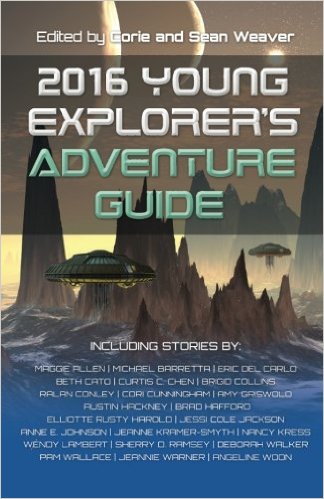
I'm delighted to have sold my story 'The Three Brother Cities' to this year's Young Explorer's Adventure Guide. And pubication of my novelette 'Briefly Thyself Remembered' will be a stretch goal for the kickstarter. wheeeee!
This marks my sale to all three of the series, so far. #nojinx 2015 and 2016
Tuesday, 31 May 2016
There Will Be Nowhere to Hide: 'Ovoids' in Spanish Translation
I'm very pleased to see 'Ovoids' in Spanish translation at Revista Axxon. It's always great to reach a new audience.
English readers can check out the original at Nature's Futures.
Friday, 27 May 2016
FAE Visions of the Mediterranean
This month sees the release of Fae Visions of
the Mediterranean, the latest
Futurefire.net Publishing anthology, featuring 24 stories and poems of horrors
and wonders of the sea. The editors Valeria Vitale and Djibril al-Ayad have
kindly agreed to appear on my blog to answer a few questions.
Q. Why did you
chose the Mediterranean as an anthology theme?
Valeria: I have always had a passion for
folktales and old mythologies, that has been frustrated recently when I
discovered how little of my own literary and anthropological tradition has been
translated into English. Also, as I often work with Mediterranean ancient
languages and artefacts, I like to imagine their journeys through time and
space, looking at the connections they might have with modern words, artistic
traditions and popular tales. Fae Visions
is a dish based on these dreams, seasoned with a pinch of sea salt, a handful
of fresh algal slime, a teaspoon of crushed cuttlebones and just a dash of
homesickness.
Q. Is there any
connection to real life events in this theme as well?
Valeria: Of course! Europe isn’t one world,
Africa another, and the Near and Middle East a third; the Mediterranean has
always been much more a road linking the peoples around it than a barrier
dividing them.
Djibril: Also of course: everything is connected to the real world,
isn’t it? Fiction tells us more about the author’s present than it does about
the fantastical distant past or the speculative far future it’s set in. Wanting
to remind people that the Mediterranean is a single world is equal parts
Valeria’s delicious recipe, and a social-political agenda: reminding ourselves
of the links between people is a radical act. Just look at the centuries of
political strife caused by those who have set up artificial boundaries between
the north and south coasts of the Mediterranean Sea.
Valeria: Probably the real life event that
made us feel most compelled to talk about this area of the world is the ongoing
tragedy of the millions of refugees seeking a new hope on the other side of the
Mediterranean. We were crushed by the idea that what has always been a
connection between peoples has now become a fence of barbed wire, guarded with
guns. The floor of the Mediterranean has seen countless shipwrecks in many centuries
of trade and travel. But I don’t think its waves have so often swallowed
desperate cries for help as now.
Djibril: Yeah, there are some horrors that are worse than
seamonsters or spawn of the underworld.
Q. I love the
cover candy for FAE, do tell me more
about it.
DA: We love the cover art too!
Tostoini is a wonderful designer and illustrator from Italy (see her portfolio
at tostoini.it/portfolio)
whose work we love—she had a free-standing artwork in the Accessing the Future anthology. When she started work on the cover
art for Fae Visions, she said she
wanted to capture the transcultural feel of Mediterranean art, from ancient
Greek vase paintings to Moroccan mosaics by way of abstract and craft-inspired
textures. We let her run with a few ideas before settling on the mosaic
sea-monster and silhouetted trireme on a semi-abstract sea under the ominous,
storm-filled skies. I’m glad you agree it turned out wonderfully—we think so
too!
Q. FAE features
stories and poems in 9 languages. What’s special about multilingual
publications? How do they impact the reader?
Valeria: We knew it could have been a risky
editorial choice, that some readers might have felt put off by fiction in
languages they are not familiar with. But we wanted people to see a polyglot
anthology as a playful invitation to have a look, maybe for the first time, at
new languages and even alphabets. We wanted our readers to go on a linguistic
adventure and maybe discover connections between words never heard before,
creating chains of thoughts linked by letters and sounds. But most of all, we
wanted the represent the intrinsically multilingual nature of the Mediterranean
and how dealing with bits of foreign languages is part of our everyday
experience, and of our identity. Language is one of the barriers we decided a
long time ago we didn’t want to let stop us.
Djibril: Absolutely! I don’t know exactly how this sort of thing
would impact a monoglot reader—I was raised bilingual and seeing text in
another language, even one I can’t understand or even read, purely thrills me.
I hope it’s the same for most people. But of course we haven’t included any
pieces in this anthology that are not accessible to a monoglot Anglophone
reader. An extract in sixteenth-century Franco-Italian handwriting is both
transcribed in typeface and translated into English; a couple of non-English
stories are translated, a few others are glossed with plot summaries in the
margins. There are back-translations, self-translations, parallel editions. I
genuinely think I could read an anthology like this full of bits of Far Eastern
languages (none of which I read a single word of) and love it. I’ve not heard
of anyone alienated by this gambit yet, so I’m optimistic!
Q. The
guidelines were welcoming to authors traditionally under-represented in Western
fiction. And I notice that you extended the deadlines for micro fiction in
Mediterranean languages and for stories from North African or Near Eastern
authors. Was the slush pile as diverse as you’d like?
Djibril: It could never be as diverse as we’d like… there’s too
much variety in the Mediterranean and the world, not only linguistically and
ethnically, but culturally, religiously, in politics and gender and ability and
identity. And yes, some parts of the Mediterranean were much better represented
than others (by content or by authors), and sometimes that was a little frustrating.
But on the whole we were delighted with the variety and diversity and sheer
quality of the slush pile, and we ended up with a lovely anthology full of
styles and media and genres and languages that we couldn’t have dreamed of,
without ever once having to select on the basis of “fit” or tokenism or
anything other than sheer love. That’s a big deal to me.
Valeria: We are very fond of the anthology
in the way it turned out to be, but the idea that some Mediterranean places,
languages and cultures are less represented than we would have liked them to be
is slowly pushing in our minds the idea of a sequel to Fae Visions with more attention to inclusion of authors and stories
from North Africa and the Near East. A second anthology could also be the
chance to try a variation in genre too, maybe opening to darker and weirder
stories or generally to give a different perspective on the wonders and terrors
of the Mediterranean.
Let’s see
how tenacious this idea will prove to be!
Djibril: I’m sold on it! But it won’t be the next thing we do…
Q. What else can
an editor do to encourage diversity? Why is this important?
Djibril: In a sense, the only
thing one needs to do to encourage greater diversity in publishing is to let
authors from underrepresented groups know that their work is valued. This means
reaching out to the communities and demographics that you think need better representation
in your publishing world—which is hard, as Claire Light has pointed
out.
It also means supporting authors, editors and publishers who are already out
there working: make sure that people from diverse backgrounds are able to be
involved in the production, selection and especially inception of creative
projects—buy their works, employ diverse editors as well as authors. And above
all, it means making sure that authors and artists you publish—not only but especially creators from
under-represented or under-privileged backgrounds—are fairly paid for their
work. Why is this important? Well, even if one didn’t care about social justice
in its various forms, who on Earth would want their reading (listening,
watching, game-playing, art consumption, etc.) to be constrained to the tiny
percentage of perspectives that are white, Anglophone, cis, male, ablebodied,
neurotypical, monied heterosexuals?
Q. I was pleased to see the call for micro
stories (although I didn’t write one) as I’ve a great fondness for very concise
fiction. What makes a successful micro fiction for you?
Valeria:
I agree! Flash fiction is such a versatile medium, it encourages experimentation
and risk-taking, and is highly subjective and so a risk in itself, almost like
poetry. I think it’s impossible to say what makes the perfect short short
story, as one of the thing I enjoy the most is exactly how diverse they can be.
But one of the thing that fascinates me the most is the necessary selection
that the authors have to make, the fact that they have to find what is really
essential to the story. And what amazes me is how, even when the stories are
reduced to their bones, they still manage to be surprising, to find new twists.
I think that writing flash fiction looks deceptively easy and quick but,
actually, it takes talent and experience to craft a good one.
Q. FAE’s
guidelines asked for horror quite prominently within the broad guidelines.
Why was that?
Djibril: We wanted to see
ghosts, pirates, monsters, ancient inscrutable evils rising from the sea. We
wanted terrible things happening to people (and terrible people happening to
things); we wanted cathartic supernaturals horrors to offset the all-too-real
horror of the world. Horror as a genre sometimes contains the most hopeful and
heartening writing, overcoming the worst strife as well as the fantasy of the
vicious receiving their comeuppance.
Valeria:
In the end we received more dark fantastic than proper horror, though. There is
a good balance of both in the anthology, so it isn’t overwhelmingly dark or
bloody. But yes, we really did want to subvert the glossy “travel agency” image
of the Med. The plan was for the anthology to talk about the second,
less-visited face of the Mediterranean Sea, using the narrative of the horror
genre to reflect and allude to the real life horrors going unnoticed there: not
only the plight of refugees but constants like pollution, overfishing, warfare.
Q. Let’s pretend that I’m a writer. What
can I do to make you buy my next story for your anthology?
Djibril: That’s a bit hard to say, as we don’t know what the next
anthology will be yet! I can say a bit about the sort of fiction we’re looking for
(in common across the anthologies and the magazine), but before I do I would
stress one thing: I don’t think any writer should try to write to our tastes,
or should try to create the sort of story we would like. Be true to yourself,
push yourself to be as good as you possibly can be on any given day, stretch
your boundaries and your experiences, make mistakes, be prepared to fail better
tomorrow, but you have to be yourself, or else it just doesn’t work.
So what
sorts of fiction, poetry and art do we like? Well, as we discussed a few
minutes ago, we’re always looking to hear from diverse and under-represented
voices—which means content as well as author, perspective as well as origin,
intention as well as history. We’re looking for speculative work, both in the
sense of science fiction, fantasy, horror, weird shit, magical realism,
surrealism, *-punk and whatever, but also in the sense of stories that are
willing to ask the real “What if” questions: not just what space exploration
could we achieve with warp drives or ansibles, but what would the social and
political implications be of a futuristic/paranormal/unreal/horrific
development; what would happen to people, what would happen to minorities, what
would happen to the privileged, to the disenfranchised, to the dissident?
Stories that are willing to be socially progressive, optimistic, cooperative,
inclusive. Stories that recognise the problems in the world—scientific, social,
ecological, political—and are not afraid to satirize, to sympathize, to
address, to shout about or even to suggest solutions to them. Most of all, any
story we publish will be beautiful, startling, poetic, creative.
Q. You’ve been
interviewing FAE authors at Future
Fire, I’d like to throw one of your own questions back at you: Do you feel a
connection with the Mediterranean Sea?
Valeria: I was born in a port city of the
South of Italy. The sea was not just landscape, it was a part of the city, it
was everywhere. I grew up with the sound of the waves cradling my thoughts. The
old city is a tiny island, hung on the land with just a bridge, as if it wasn’t
really convinced it was a good idea. Just before the bridge, there are two
massive Doric columns. They are the only relics of a temple dedicated to
Poseidon, overlooking the sea. Even surrounded by traffic and indifference,
they still manage to look magnificent. Powerful. My city was sacred to the god
of the sea and was also known as Neptunia when it was a Roman colony. Then we
had the Normans, the Turks, the French, the Spaniards. They left us one of
their castles protecting the entrance of the port. Funnily enough, we made it
one of our most beloved places. Near the castle, just past the bridge, there is
one of the loveliest things you can find in my city: a monument to the sailors.
It can be seen clearly only from the ships. It’s nothing conceptual or too
aesthetically daring. It just says “ciao” to all the sailors who arrive or
leave, so that they always feel welcome to come and return.
Everything
speaks about the sea in the place I come from, everything and everyone is
connected to it. And I long for it almost everyday that I spend in my new
country.
Valeria Vitale is a researcher in nonexistent worlds and disappeared cities. When she’s not busy writing and reading, you may find her staring at ancient objects in museums or modelling buildings in 3D. She likes ghosts, vampires and old mythologies. And crocodiles.
Djibril al-Ayad is the nom de guerre of a historian, futurist, writer, editor of The Future Fire, magazine of social-political speculative fiction, and co-editor of five anthologies. His interests span science, religion and magic; education and public engagement; diversity, inclusivity and political awareness in the arts.
Wednesday, 25 May 2016
Cold Relations All Round: Flash Fiction in Polish Translation
After being recently podcast 'The Frozen' have has decided to nip off to Poland. Thank you for the translation, Szortal.
English readers can view the original, 'The Frozen Hive of Her Mind' here.
Subscribe to:
Posts (Atom)